
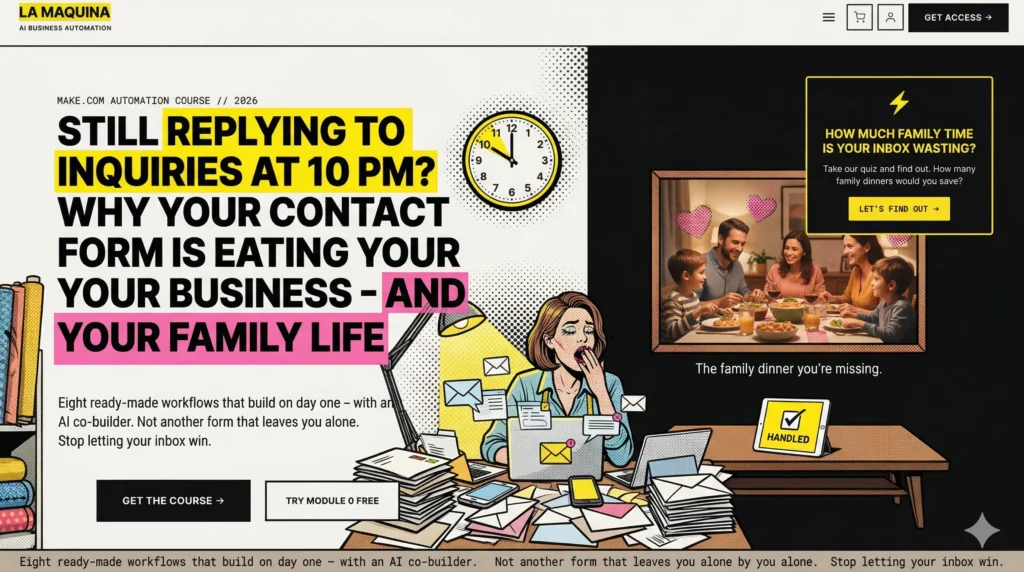
It’s Monday evening, half past nine. The kids are asleep – at least you hope so. You’re on the couch with your laptop, scrolling through incoming emails. Three new inquiries from your contact form. One could wait until tomorrow, but you know that by morning, five other things will feel more urgent. The second one needs a quote, but that means digging up your pricing sheet. The third is a question you’ve already answered a hundred times.
From the other room, your partner asks if you’re going to watch that show you’ve been talking about for two weeks.
“Just a minute, let me finish this.”
Sound familiar?
If so, you’re not alone. Small business owners spend over a third of their entire work week on admin, and email alone eats up nearly a third of working hours. That’s 24 full working days per year spent exclusively reading and replying to emails. Twenty-four days you could be spending on strategy, on clients, or simply resting.
But the most painful number isn’t even that. 68% of entrepreneurs spend the majority of their time on daily firefighting and routine tasks – and only 32% on actually building their business.
The “I’ll Just Do It Myself” Trap
There’s a psychological phenomenon called the illusion of control. We believe that if we personally reply to every inquiry, the response will be better. We know our own services, we know what to say, and we know who’s a serious prospect.
That’s partly true. But think about what actually happens:
An inquiry comes in through the form. You read it. You mentally categorize it – this one’s about services, that one’s a project request, this one’s just browsing. You dig up a similar reply you’ve sent before, or you write a new one. You send it. Done.
Then the next one comes. And the next. And the point is always the same: 70-80% of your replies are essentially identical. Different name, different company, but the information you’re providing is almost always the same.
Yet every single time, you sit down, write it out, and hit send. Because “I’ll just do it myself, it’s faster than explaining it to someone.”
This mindset is one of the biggest traps for small business owners. Psychology explains it with two phenomena: the sunk cost fallacy – “I’ve always done it this way, I’m not going to change now” – and delegation anxiety. Research shows that 75% of entrepreneurs struggle with handing off tasks because they don’t trust anyone else to do it well enough.
But here’s the twist: it doesn’t have to be someone else. I’m not talking about hiring an employee or a virtual assistant.
The Invisible Price You’re Paying
Before we talk about solutions, let’s look at what you’re actually losing when you’re sitting in front of your laptop at ten o’clock at night.
Your family’s time. This doesn’t need explaining, but it’s worth saying out loud. The words “just a minute” have a very different meaning in a small business owner’s home. Your partner knows it, your kids know it, and you know it. There’s always just one more email.
According to Randstad’s 2024 Workmonitor study, work-life balance is the second most important factor for 33% of workers globally, right after salary – and this doesn’t apply to employees only. Business owners suffer from the same imbalance, except there’s no HR department organizing a wellbeing program for them. They have to set their own boundaries.
Your paying clients’ time. Every minute you spend replying to a general inquiry is a minute you’re not spending with your premium clients. Economics calls this opportunity cost, and it’s brutally simple: if your hourly rate is $50, and you spend an hour a day replying to inquiry emails, that’s $1,000 a month in lost revenue. Not a cost you paid – revenue you never received.
Your own energy. Decision fatigue is a real phenomenon. Every “which template should I use,” “how should I phrase this,” “how detailed should this reply be” decision drains you. Research shows we’re capable of a limited number of good decisions per day. If you spend those on inquiry emails, you’ll have fewer left for the business decisions that actually matter.
Your response time. If you’re the only person who can reply, what happens when you’re sick? On vacation? When you simply don’t check email for a day? Your potential client won’t wait. Studies show that 78% of prospects go with the provider who responds first. Not the best one – the first one.
The Paradox: Personal, But Not Personally
This is where most small business owners get stuck. Because one thing is clear: a personal response matters. Your potential client wants to feel like they wrote to a human being – and got a human reply.
But think about it: what makes a response feel personal?
It’s not the fact that you typed it by hand at ten at night. It’s that the person got exactly the information they needed, relevant to their situation, quickly and helpfully.
In psychology, this is called the reciprocity principle: when someone receives a valuable, attentive response quickly, they feel stronger trust toward the sender. It doesn’t matter whether you were physically sitting behind the screen – what matters is that the person feels taken care of.
Think about it: when you order something online and immediately get a confirmation email with all the details, it’s reassuring. You don’t ask whether a human wrote it. What matters is that you got what you expected, when you expected it.
When someone inquires about your services, it doesn’t matter whether you personally wrote the reply at eleven at night. What matters is that they get the key information: what the service covers, how it works, what it costs, and how to get started. You don’t need to manually assemble this information every single time.
When someone reaches out with a custom project request – say, they want automation built for their business – that’s a different situation. That genuinely requires a unique response. But even there: the first step – confirming you received their message and will reply in detail soon – why would you type that by hand every time?
There’s a line. Below it, automation takes nothing away from the personal experience while giving you back hours of your day. Above it, your human attention is truly essential.
The trick is recognizing where that line falls.
What Can Be Automated – and What Can’t
Let’s get specific.
Can and should be automated:
The instant confirmation that you received the message. Recognizing and categorizing the type of inquiry – service question, project request, general question. Automatically sending the right information based on the inquiry type. Recording the contact’s details in a spreadsheet so you don’t have to copy them manually. The notification that alerts you when something urgent comes in, so you don’t have to constantly refresh your inbox.
Cannot and should not be automated:
Pricing and scoping custom projects. Giving a personal reply to complex questions. The trust-building conversation that happens before a premium engagement. The human judgment that tells you whether this lead will become a client.
The point: it’s not about automating everything. It’s about not manually doing the repetitive, templatable steps – so you can direct your human attention where it truly counts.
The Psychological Barrier: “But My Business Is Different”
I know what you’re thinking. “This wouldn’t work for me. My clients are special. My service is so unique that you can’t send a template response.”
This is what psychology calls status quo bias. People tend to prefer the current state of affairs because change feels risky and exhausting. “It’s worked so far, why would I change?”
Because it hasn’t worked. You’ve just gotten used to it.
You’ve gotten used to sitting in front of your laptop at ten at night. You’ve gotten used to spending part of your weekend answering inquiries. You’ve gotten used to your inbox being the first thing you check in the morning and the last thing you close at night.
But if I asked you: “When you started your business, is this what you imagined?” – I know what you’d say.
Every Business Is Different – and Yet
You’re right that every business is different. A hairdresser writes differently than a project manager. A mom running an online store uses different language than an IT freelancer.
But there’s something they all share: the structure of messages coming through a contact form. They can be categorized by type. The first response is almost always standardizable. And the admin steps – logging, categorizing, notifying – are always the same.
That’s not a compromise. That’s common sense.
Think of it like a receptionist at a doctor’s office. The doctor doesn’t pick up the phone and schedule appointments. But the patient still gets personal care when they sit down in the consulting room. The receptionist doesn’t reduce the value of the service – quite the opposite, they make it possible for the doctor to focus on what they’re actually good at.
Your business can have a digital “receptionist” too – one that receives inquiries, categorizes them, provides the initial information, and only pings you when your human attention is genuinely needed.
Behind “You Can’t Automate This” Is Actually Fear
When someone says “my work can’t be automated,” it’s worth examining what’s behind it. In most cases, it’s not a rational analysis – it’s two very human emotions.
The first is fear of losing control. “If I’m not the one replying, what if my client gets the wrong answer? What if I lose a deal?” That’s a valid concern – but only if you’re stuck in all-or-nothing thinking. Nobody’s saying you should hand over your entire client relationship to a robot. But those five minutes it takes to type “Thanks for reaching out, I’ll get back to you with details soon” – why are you guarding that so fiercely?
The second is a question of identity. Many small business owners conflate admin with work. If I’m not answering emails, what am I doing? Am I even “working”? This is the dark side of the Zeigarnik effect: unfinished tasks (unanswered emails) occupy the brain so intensely that answering them provides a moment of relief. It’s almost addictive. Check, done, I did something. Meanwhile, the strategically important task – the one that actually grows your revenue – keeps getting postponed.
What Happens If You Don’t Change?
This has its own psychology too. Loss aversion is one of the strongest human motivations – research shows that the pain of loss is roughly twice as powerful as the pleasure of an equivalent gain.
So think about what you’re losing if everything stays the same:
A year from now, you’ll still be sitting in front of your laptop at ten at night. You’ll spend 24 working days on email. Your business won’t grow because you’re the bottleneck – everything flows through you. Some of your prospects will buy elsewhere because you couldn’t respond fast enough. And your kids will be a year older, without you being there on all those evenings.
Not because you’re a bad business owner. But because you’re handling a solvable problem by hand, day after day.
The First Step Isn’t Technology
If you’re expecting me to tell you which software to buy – I won’t. Because the first step isn’t technology.
The first step is to observe, for one week, how many minutes you spend replying to inquiries from your contact form. Write it down – don’t estimate, actually write it down. Most people are stunned by the result.
The second step is to categorize your inquiries. How many types are there? How many of them get essentially the same reply? Where do you genuinely need to give a unique, personal response?
The third step is to decide: how much time do you want to spend on this? Not zero – because that’s impossible and wouldn’t be good anyway. But how much less would be enough?
Once you answer these questions, it becomes clear what’s worth automating and what isn’t. And at that point, you’re no longer driven by fear or uncertainty – you’re driven by data.
The Point: Automation Isn’t the Goal – You Are
This article isn’t about technology solving everything. It’s not about personal connection being worthless either – quite the opposite.
It’s about the fact that your time is your business’s most valuable resource. Every minute you spend on something a well-configured system could handle is a minute you’re taking from your family, your paying clients, or yourself.
Entrepreneurs who delegate or automate routine tasks report 40% less stress and are significantly more satisfied with both their work and personal lives. That’s no coincidence. When you’re no longer the bottleneck, your business can breathe – and so can you.
So next time you’re on the couch at ten at night with your laptop, wondering whether to write that last reply: pause for a moment. The question isn’t whether you can do it. It’s whether you should.
This is what I do: I help small business owners identify and automate the processes that unnecessarily eat their time. If you want to learn how to do it yourself, check out my business automation course built on Make.com, or download one of my free blueprint templates to see how simple the first step can be.

Susana Toth
Make.com Certified Expert & Founder, La Maquina Studio
Susana Toth is a Make.com Certified Expert and the founder of La Maquina Studio, where she helps small businesses and consultants eliminate repetitive work through smart automation. With 20+ years of experience in web design, business consulting, and digital strategy, she builds practical AI-powered workflows that save hours every week — without writing a single line of code. She writes about Make.com automation, AI integration, and building systems that work while you don’t.
Learn more about me →