
When it comes to make.com vs ActiveCampaign automation, business owners often find themselves at a crossroads trying to decide which platform best suits their needs. Both Make.com and ActiveCampaign offer unique automation capabilities, but they cater to slightly different use cases and audiences. Make.com is renowned for its flexibility and expansive integrations, making it ideal for businesses with complex automation needs. On the other hand, ActiveCampaign is celebrated for its robust marketing automation and CRM features, making it a favorite among marketers and sales teams. As a seasoned expert in business automation, I’ve had the privilege of implementing both platforms for various clients, and I can attest to their strengths and weaknesses. In this article, we will explore the key differences between Make.com and ActiveCampaign, referencing specific workflows, to help you determine which platform aligns better with your business goals.
Table of Contents
Understanding the Core Differences
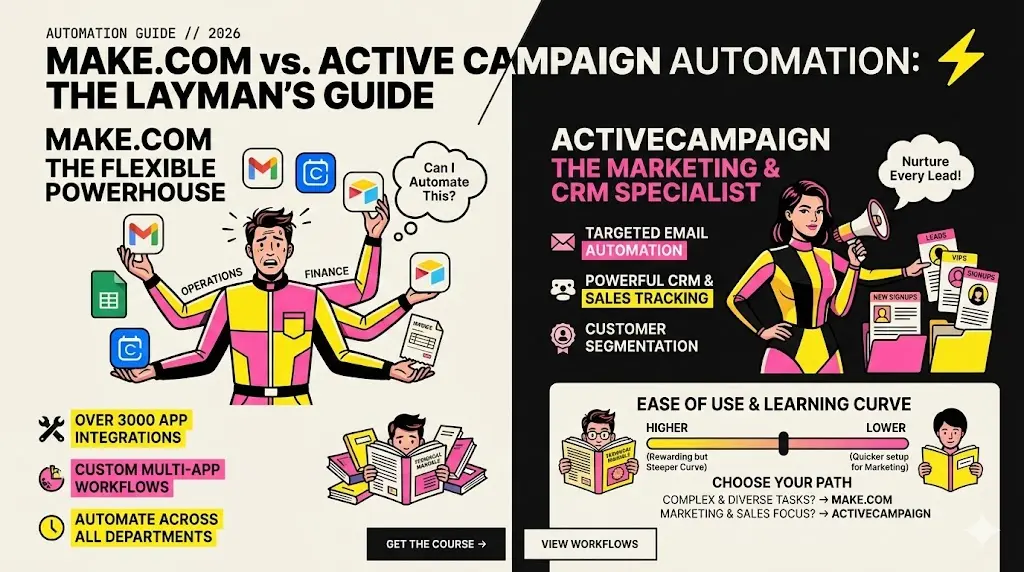
At its core, the debate of make.com vs ActiveCampaign automation revolves around flexibility versus specialization. Make.com, formerly known as Integromat, is a powerhouse of flexibility. It allows users to connect a wide range of apps and services, offering an environment where you can create intricate workflows akin to a digital Swiss Army knife. Whether you need to automate email responses, manage bookings, or even generate instant quotes, Make.com provides the tools to do so with workflows like our Smart Contact Form and Instant Quote Machine.
ActiveCampaign, however, is more specialized. It focuses heavily on email marketing, marketing automation, and CRM functionalities. Its strength lies in its ability to nurture leads and manage customer relationships through targeted email campaigns and automated workflows. This makes it ideal for businesses that prioritize customer engagement and retention efforts. Unlike Make.com, which requires a learning curve to harness its full potential, ActiveCampaign tends to be more user-friendly for those specifically focused on marketing automation.
The choice between these platforms depends largely on what your business needs to achieve. If your goal is to automate diverse tasks across different departments, Make.com’s breadth might be more suitable. On the other hand, if your main focus is marketing, ActiveCampaign’s specialized features could serve you better.
Use Cases and Practical Applications
When comparing make.com vs ActiveCampaign automation, it’s crucial to consider their practical applications. Make.com shines in scenarios requiring the integration of multiple apps and services, especially when those services do not natively support each other. For example, our Booking Assistant workflow automates the process of managing appointments across platforms like Calendly, Google Calendar, and MailerLite without any manual intervention. This kind of cross-platform capability is where Make.com truly stands out.
In contrast, ActiveCampaign excels in scenarios where businesses need to engage customers through targeted communication strategies. Its platform is designed to automate repetitive marketing tasks, such as sending follow-up emails, segmenting email lists, and tracking customer interactions. For businesses heavily invested in email marketing, ActiveCampaign offers a streamlined process to enhance customer journeys and boost engagement.
Ultimately, the decision between the two platforms can hinge on the nature of your business operations. If your business needs span multiple functions beyond marketing—such as operations, finance, or content management—Make.com offers a more comprehensive solution. However, if your primary business function revolves around maintaining and nurturing customer relationships through personalized marketing efforts, ActiveCampaign will likely provide the most value.
Integration Capabilities
Another key aspect in the make.com vs ActiveCampaign automation discussion is integration capabilities. Make.com is celebrated for its vast library of integrations, supporting over 3,000 apps across various categories. This extensive range allows businesses to create highly customized workflows that seamlessly connect disparate systems. For instance, our Auto-File Invoices workflow leverages Make.com’s ability to integrate Gmail and Google Drive, automating the tedious task of organizing financial documents.
ActiveCampaign, while less expansive in terms of app integrations, offers deep integrations with popular marketing tools and platforms. It integrates seamlessly with tools like Shopify, WordPress, and Zapier, enhancing its ability to serve as a central hub for marketing activities. These integrations support businesses in creating cohesive marketing campaigns that are informed by data from various sources.
The choice here really boils down to the complexity of your integration needs. If your business relies on multiple apps that need to work together in intricate ways, Make.com is the clear winner. Its integration capabilities are virtually limitless. However, if your integration needs are primarily within the realm of marketing and sales, ActiveCampaign’s dedicated integrations may be more than sufficient.
Ease of Use and Learning Curve
Ease of use is an essential factor when evaluating make.com vs ActiveCampaign automation. Make.com offers a visually intuitive interface that allows users to design workflows through a drag-and-drop system. Despite its straightforward interface, Make.com does come with a learning curve, especially for those new to automation. The platform’s flexibility can sometimes be overwhelming, requiring time and experimentation to master all its features.
Our courses are designed to mitigate this learning curve by providing step-by-step guidance on implementing key workflows, such as the Review Response Bot or the Auto Blog Writer. These courses empower users to build confidence in using Make.com effectively.
Conversely, ActiveCampaign is known for its user-friendly approach, particularly in the realm of marketing automation. The platform is designed to accommodate users who may not have extensive technical expertise. This makes it accessible for small business owners and marketers who need a solution that can be set up quickly and easily. ActiveCampaign’s guided setup processes and extensive documentation further simplify the user experience.
If you’re willing to invest time in learning, Make.com’s potential for customization can be incredibly rewarding. However, if simplicity and quick deployment are your priorities, ActiveCampaign offers a more straightforward path.
Conclusion
In the end, the decision between make.com vs ActiveCampaign automation should be informed by the specific needs and priorities of your business. Make.com offers unparalleled flexibility and a broad range of integrations, making it ideal for businesses that require comprehensive, cross-departmental automation solutions. Its capabilities extend beyond just marketing, providing value to various business functions. However, this comes with a steeper learning curve that requires investment in time and resources to fully leverage its potential.
ActiveCampaign, on the other hand, specializes in marketing automation and CRM, making it perfect for businesses focused on customer engagement and lead nurturing. Its ease of use and marketing-centric features offer a more immediate return on investment for those with marketing-heavy operations.
Ultimately, both platforms have their own merits, and the right choice depends on your business’s specific goals and technical capacity. Consider what areas of your business would benefit most from automation and weigh those needs against the strengths of each platform. By doing so, you’ll be better positioned to select a solution that not only meets your current needs but also supports your growth in the future.
Check out the courses you can learn in just a few days and implement in your business! Need help? Get in touch with me!


Susana Toth
Make.com Certified Expert & Founder, La Maquina Studio
Susana Toth is a Make.com Certified Expert and the founder of La Maquina Studio, where she helps small businesses and consultants eliminate repetitive work through smart automation. With 20+ years of experience in web design, business consulting, and digital strategy, she builds practical AI-powered workflows that save hours every week — without writing a single line of code. She writes about Make.com automation, AI integration, and building systems that work while you don’t.
Learn more about me →