
When pondering the question, is automation worth it for small business, it’s essential to consider not only the immediate cost savings but also the broader impact on workflow efficiency and customer satisfaction. As a small business owner, every decision feels significant. You constantly balance between investing in growth and maintaining the day-to-day operations with limited resources. Automation appears as a shiny promise of efficiency and time savings, a way to achieve more with less. Yet, like any investment, it requires a careful analysis of potential returns. Understanding how automation can transform your business operations involves evaluating each process, its current inefficiencies, and how technology can offer solutions.
At La Maquina Studio, we’ve seen firsthand how implementing the right automation strategies can be a game-changer. By leveraging Make.com workflows, we provide businesses with tailored solutions that address specific operational challenges. But before diving into the technicalities, let’s explore the broader landscape of automation for small businesses. How do we calculate the ROI on automation? How does it fit into the existing structure? And most importantly, why should a small business invest in automation now?
Table of Contents
The Potential of Automation in Small Businesses
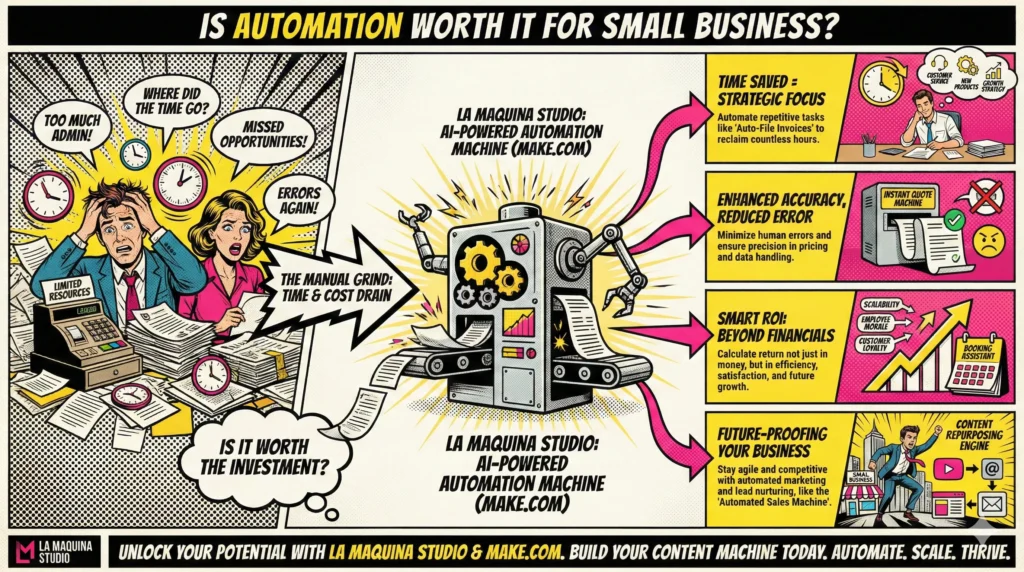
Small businesses often operate on tight margins, where every dollar counts, and time is an equally crucial resource. The question of is automation worth it for small business often hinges on these two aspects: cost and time savings. Automation can significantly streamline daily operations, reducing the manual handling of repetitive tasks, which in turn allows employees to focus on more strategic initiatives.
Take, for instance, the Auto-File Invoices workflow. This intermediate-level automation, which involves Gmail, Filter, and Google Drive, addresses the common pain point of manual invoice filing. By automating this process, businesses can save countless hours each month that would otherwise be spent on tedious administrative tasks. This time can then be redirected towards activities that drive growth, such as improving customer service or developing new products.
Moreover, automation can enhance accuracy and reduce human error—a critical consideration for businesses that handle sensitive data or have strict compliance requirements. The Instant Quote Machine, for example, uses a Webhook, Sheets, OpenAI, PDF, and Email to streamline quote creation. This advanced workflow ensures consistency and precision in pricing, reducing the risk of costly errors.
Yet, the journey to automation is not without challenges. It’s essential to maintain a realistic perspective. Automation is not a magic bullet but a tool that, when implemented correctly, can lead to significant efficiencies. It requires an upfront investment of time and resources to set up, along with a willingness to learn and adapt.
Understanding the ROI of Automation
Calculating the return on investment (ROI) for automation is complex but essential in determining is automation worth it for small business. The traditional ROI formula—(Gain from Investment – Cost of Investment) / Cost of Investment—takes on additional layers when applied to automation. Beyond immediate financial gains, you must also consider long-term benefits such as increased scalability and improved customer satisfaction.
For service-based businesses, where the primary resource is time, automations like the Booking Assistant become invaluable. By automating booking management via Calendly, Calendar, Email, and MailerLite, businesses can prevent scheduling conflicts and ensure that appointments are optimized for both client and service provider. This not only saves time but also frees up resources that can be better utilized elsewhere.
When evaluating ROI, factor in both tangible and intangible outcomes. Tangible benefits include direct cost savings from reduced labor hours and decreased errors. Intangible benefits, however, extend to improved employee morale, as automation can alleviate the burden of monotonous tasks, and enhanced customer experiences, leading to increased customer loyalty and referrals.
Make.com workflows, like the Automated Sales Machine, epitomize how automation can transform lead nurturing processes. By automating sequences from Tally to AI, Router, PDF, and Email sequences, businesses can efficiently manage leads, ensuring timely follow-ups and personalized communication, which is crucial for conversion.
Implementation Considerations for Small Businesses
While the benefits of automation are clear, implementation requires careful planning and strategy. One of the first steps is identifying which processes are ripe for automation. Typically, these are repetitive, time-consuming tasks that do not require complex decision-making. Once identified, mapping out these processes in detail is crucial to ensure that the automation fits seamlessly into the existing workflow.
The Smart Contact Form is an excellent starting point for those new to automation. It uses Webhooks, OpenAI, and Email to automate responses to contact form submissions, thereby eliminating one of the most common time drains for small businesses. By starting with such workflows, businesses can gain quick wins and build confidence in further automation initiatives.
Equally important is choosing the right tools and platforms. Make.com offers a user-friendly interface and a range of integrations that cater specifically to the needs of small businesses. Its flexibility allows businesses to customize workflows to their unique requirements, ensuring that the automation is both effective and scalable.
Training and change management are also critical components of successful automation implementation. Employees should be adequately trained not only in how to use the new tools but also in understanding the broader benefits of automation. This can help alleviate any resistance to change and foster a culture that embraces innovation and efficiency.
The Role of Automation in Future-Proofing Businesses
In an increasingly digital world, the question of is automation worth it for small business extends beyond immediate gains to consider long-term sustainability and competitiveness. As consumer expectations shift towards faster, more personalized services, small businesses must adapt to remain relevant and competitive.
The Content Repurposing Engine, for example, demonstrates how automation can keep businesses agile in their marketing efforts. By automating content repurposing from YouTube RSS to Gemini AI and Email, businesses can maintain a consistent online presence without the need for a large marketing team. This allows small businesses to compete with larger players, leveling the playing field.
Furthermore, adopting automation can position a business as forward-thinking and technologically savvy, attributes that are increasingly appealing to both customers and potential employees. A business that effectively utilizes technology to enhance its operations is likely to attract talent that values innovation and efficiency.
Ultimately, the decision to automate should align with a business’s strategic goals. Automation is not an end in itself but a means to enhance the business’s capabilities, ensuring it can adapt and thrive in a rapidly evolving market landscape.
Conclusion
The question of is automation worth it for small business involves a nuanced consideration of potential benefits against the investment required. While the initial setup may seem daunting, the long-term gains in efficiency, accuracy, and customer satisfaction can far outweigh these challenges. By carefully evaluating processes, calculating ROI, and implementing strategies that align with business goals, small businesses can unlock the full potential of automation.
La Maquina Studio is committed to guiding small businesses through this journey. Whether you’re looking to start small with a Smart Lead Qualifier or dive into more complex workflows like the Automated Sales Machine, our expertise in Make.com workflows ensures that your transition to automation is both smooth and successful. Embrace the future of business operations and transform the way you work. The potential rewards are indeed worth the effort.

Susana Toth
Make.com Certified Expert & Founder, La Maquina Studio
Susana Toth is a Make.com Certified Expert and the founder of La Maquina Studio, where she helps small businesses and consultants eliminate repetitive work through smart automation. With 20+ years of experience in web design, business consulting, and digital strategy, she builds practical AI-powered workflows that save hours every week — without writing a single line of code. She writes about Make.com automation, AI integration, and building systems that work while you don’t.
Learn more about me →