
In today’s rapidly evolving digital landscape, AI automation small business emerges as a beacon of promise for entrepreneurs looking to level the playing field. Automation promises efficiency, cost-effectiveness, and an overall transformation in how businesses operate. However, navigating the world of AI automation isn’t as straightforward as it may seem, especially for small business owners who juggle numerous hats. While the potential benefits of integrating AI into your business processes are immense, understanding the reality beyond the hype is crucial. This article aims to explore the practical realities of AI automation for small businesses, dispelling myths and providing grounded insights along the way.
As a small business owner, you may find the notion of automation both alluring and daunting. The promise of streamlined operations, reduced manual labor, and elevated customer experiences can seem like the perfect solution to many business woes. Yet, beneath this alluring promise is the reality of the learning curve and integration challenges that may not always be evident at first glance. With tools like Make.com and its automation workflows, small businesses do have the resources to implement effective automation strategies, but these come with their own set of challenges and considerations. In this article, we peel back the layers of AI automation for small businesses, examining both the hype and the hard truths to help you make more informed decisions.
Table of Contents
The Promise and the Allure
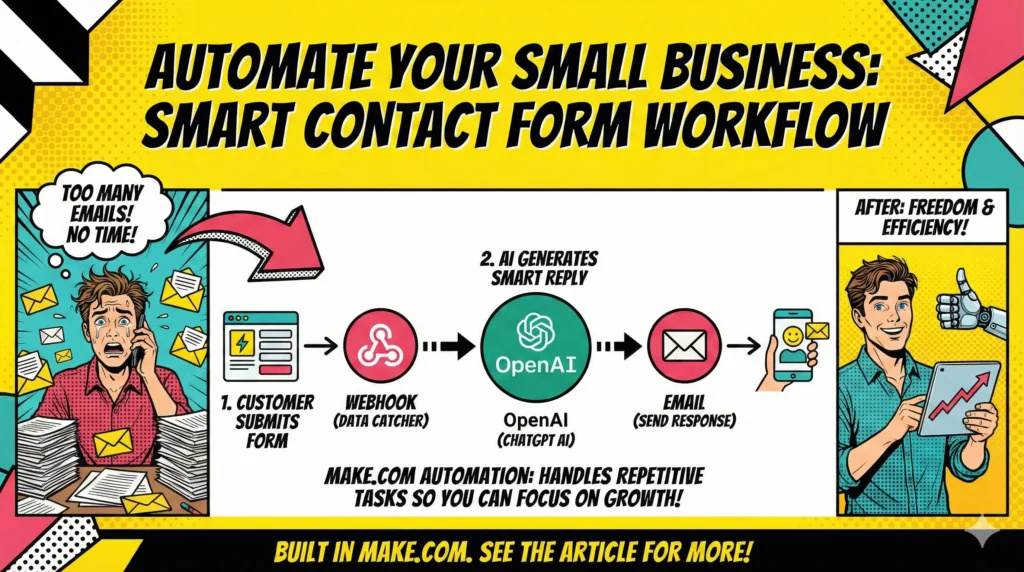
The allure of AI automation for small businesses often begins with the promise of doing more with less. Automation tools claim to handle repetitive tasks with precision, allowing business owners to focus on growth and innovation rather than administrative drudgery. This promise is not unfounded. For instance, the Smart Contact Form workflow using Make.com can automate email responses, saving countless hours otherwise spent on manual emailing. But it’s essential to dig deeper than just the surface-level promise.
The hype around AI automation can sometimes lead small business owners to believe that simply adopting automation tools will lead to immediate results. However, the reality is that automation requires a strategic approach. Identifying the right processes to automate, ensuring seamless integration with existing systems, and training teams to use these new tools effectively are critical steps that often get overlooked in the initial excitement.
For example, while the Auto-File Invoices workflow offers a clear-cut solution to manual invoice filing, implementing this involves understanding the nuances of how your invoicing system currently operates. It requires a mapping of current processes and potential adjustments to ensure the automation fits seamlessly into workflows. Thus, while the allure is justified, the journey involves meticulous planning and adaptation.
Moreover, automation is not a one-size-fits-all solution. Each small business has unique needs, and what works for one might not work for another. A comprehensive assessment of business processes, goals, and resources is vital to determine which areas will benefit most from automation. This strategic approach helps set realistic expectations and paves the way for successful implementation.
Understanding the Learning Curve
While the promise of AI automation for small businesses is certainly appealing, the learning curve associated with these technologies represents a significant hurdle. Many business owners, eager to jump on the automation bandwagon, quickly realize the complexities involved in effectively leveraging these tools. Unlike larger organizations with dedicated IT departments, small businesses often operate with limited technical expertise, making the adoption of AI more challenging.
Consider the Booking Assistant workflow, which automates booking management by integrating platforms like Calendly, Google Calendar, Email, and MailerLite. While the workflow itself is designed to simplify scheduling, understanding each component’s role and ensuring they work harmoniously requires time and effort. It’s not uncommon for small business owners to experience initial setbacks as they navigate these new territories.
The key to overcoming the learning curve is education and support. Investing time in learning about the tools you’re implementing, either through online resources or courses like those offered by La Maquina Studio, can make a significant difference. Additionally, seeking expert guidance or consulting services can help demystify the process and provide tailored solutions that align with your business’s specific needs.
It’s important to remember that the learning curve is a natural part of adopting any new technology. While it may require patience and persistence, the long-term benefits of automation often justify the initial investment of time and resources. Success is not measured by how quickly you implement automation but by how effectively you integrate it into your business operations.
Practical Implementation Challenges
Beyond the learning curve, small businesses face various practical challenges when implementing AI automation. One common issue is the integration of automation solutions with existing systems. Many small businesses rely on a patchwork of tools and platforms that may not always play nice together. Ensuring that new automation workflows integrate smoothly with these systems requires careful planning and often, technical aptitude.
Take the Content Repurposing Engine workflow, for example, designed to automate content repurposing from YouTube RSS feeds to email drafts. While this process is beneficial in reducing manual efforts, ensuring compatibility with your existing content management systems is essential. A failure to do so could result in data silos or workflow disruptions, negating the benefits of the automation.
Another challenge is maintaining the quality of output. With automation, there’s always a risk of errors propagating at scale. For instance, the Review Response Bot facilitates automated responses to reviews on platforms like Google My Business. However, ensuring that these responses maintain the brand’s voice and adequately address customer concerns requires diligent oversight and possibly some level of human involvement.
To mitigate these challenges, small businesses should take a phased approach to automation, starting with lower-risk processes before scaling up. Regularly reviewing and optimizing automation workflows can also help maintain quality and compatibility over time. Additionally, fostering a culture of innovation and adaptability within your team can ease the transition and promote successful adoption of these technologies.
Real Benefits vs. Overblown Expectations
In the realm of AI automation for small businesses, distinguishing between real benefits and overblown expectations is crucial for success. While automation does offer substantial advantages, it’s essential to recognize that it is not a panacea for all business challenges. Understanding what automation can and cannot do will help you set realistic goals and achieve measurable results.
Consider the Instant Quote Machine workflow, which automates the creation and delivery of quotes. This workflow significantly reduces the time and effort required to manage quotations, allowing sales teams to focus on higher-value activities. However, expecting automation to replace human judgment or creativity entirely is an overblown expectation. Human oversight remains crucial for ensuring the quality and relevance of quotes, especially in complex scenarios.
Moreover, while automation can reduce errors and increase efficiency, it isn’t immune to occasional mishaps. For instance, the Auto Blog Writer workflow can streamline content creation, but it requires careful supervision to maintain accuracy and relevance. Human editors are still necessary to review and refine the output before publishing.
By recognizing the real benefits of AI automation and aligning them with realistic expectations, small businesses can harness the full potential of these technologies. This approach enables you to make informed decisions, prioritize automation initiatives that deliver the most value, and ultimately drive sustainable growth and efficiency.
Conclusion: The Balanced Perspective
As we conclude this exploration of AI automation small business, it’s evident that while the hype surrounding automation is not entirely unwarranted, a balanced perspective is crucial for successful implementation. AI automation offers transformative benefits, from streamlining operations to enhancing customer experiences. However, it’s essential for small business owners to approach automation with a strategic mindset, acknowledging the learning curves and practical challenges involved.
By leveraging resources like the Make.com workflows and seeking expert guidance, small businesses can navigate the complexities of automation effectively. The journey requires patience, persistence, and a willingness to adapt, but the long-term rewards are well worth the effort. Automation is not a magical solution, but when used wisely, it can empower small businesses to compete on a larger stage, driving innovation and growth.
Ultimately, the key to success lies in understanding the real capabilities of AI automation and aligning them with your business goals. By doing so, you can harness the power of automation to optimize operations, free up valuable resources, and focus on what truly matters—delivering value to your customers and achieving sustainable business success.


Susana Toth
Make.com Certified Expert & Founder, La Maquina Studio
Susana Toth is a Make.com Certified Expert and the founder of La Maquina Studio, where she helps small businesses and consultants eliminate repetitive work through smart automation. With 20+ years of experience in web design, business consulting, and digital strategy, she builds practical AI-powered workflows that save hours every week — without writing a single line of code. She writes about Make.com automation, AI integration, and building systems that work while you don’t.
Learn more about me →