
Small business automation 2026 represents a transformative era for entrepreneurs seeking efficiency, growth, and enhanced customer experiences. As a small business owner, you may feel the weight of numerous repetitive tasks that consume valuable time and divert attention from strategic growth activities. The year 2026 is a pivotal moment for automation, offering advanced solutions to streamline operations and optimize business processes. Leveraging tools like Make.com, businesses can integrate automation into their workflows, leading to increased productivity and profitability. However, the path to automation is not without its challenges. Understanding the learning curves and practical applications of automation tools is essential for successful implementation. This guide will explore the potential of small business automation in 2026, showcasing practical workflows and insights to empower your business journey.
Table of Contents
The Evolution of Small Business Automation
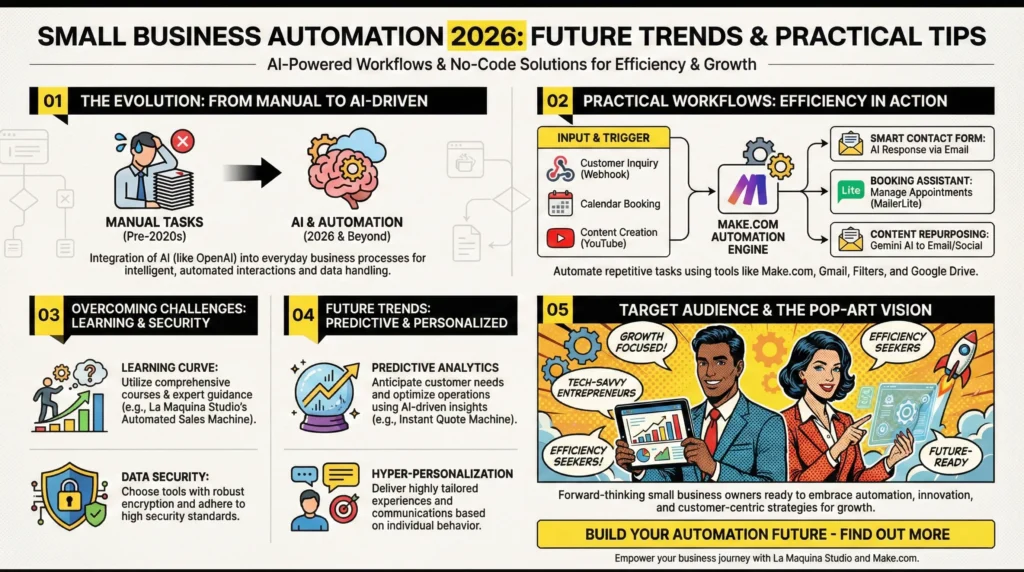
The landscape of small business automation 2026 is vastly different from what it was just a few years ago. Businesses are increasingly adopting automation technologies to stay competitive and meet the growing expectations of customers. The evolution of automation has been driven by advancements in technology, the increased accessibility of automation tools, and the need for businesses to operate more efficiently.
One of the significant changes in small business automation 2026 is the integration of artificial intelligence (AI) into everyday business processes. AI-powered automation tools can now handle complex tasks that were previously thought to be uniquely human. For instance, using the Smart Contact Form workflow from La Maquina Studio, businesses can automate responses to customer inquiries, saving time and improving response rates. This workflow integrates a webhook with OpenAI and email, providing intelligent, automated interactions with customers.
Additionally, the evolution of automation tools has made them more accessible to small businesses. Previously, automation was seen as a luxury only large enterprises could afford. However, platforms like Make.com have democratized automation, offering affordable solutions that are easy to implement and scale. The Auto-File Invoices workflow is a perfect example of how small businesses can harness automation to eliminate time-consuming tasks like manual invoice filing, using tools such as Gmail, Filters, and Google Drive.
As we look towards 2026, small businesses are not only expected to adopt automation extensively but also to innovate how these technologies are utilized. The integration of AI and machine learning into automation will enable businesses to predict trends, personalize customer experiences, and make data-driven decisions with unprecedented accuracy.
Practical Applications of Automation Workflows
Exploring the practical applications of small business automation 2026 involves understanding how specific workflows can transform key business operations. Whether you’re managing customer interactions, handling content, or nurturing leads, automation offers a pathway to efficiency and effectiveness.
Take, for example, the Booking Assistant workflow from La Maquina Studio, which automates booking management. By connecting MailerLite, a calendar, email, and MailerLite, businesses can seamlessly manage appointments and follow-ups without manual intervention. This automation reduces the risk of double-booking or missed appointments and enhances customer satisfaction with timely communications.
In the realm of content management, the Content Repurposing Engine workflow comes into play. By automating the process of repurposing YouTube content through Gemini AI and email, small businesses can maintain a steady flow of content across multiple platforms. This not only saves time but also maximizes the reach and impact of existing content.
For businesses heavily reliant on customer feedback, the Review Response Bot offers a practical solution for automating review responses. Integrating Google My Business with AI through a router, this workflow ensures that customer reviews are acknowledged and responded to promptly, fostering positive customer relationships and reputation management.
These practical applications underscore the potential of small business automation 2026 to revolutionize how businesses operate, allowing them to focus on strategic growth and innovation.
Overcoming Challenges in Automation Implementation
While the benefits of small business automation 2026 are compelling, businesses must be prepared to navigate the challenges that come with implementation. Understanding these challenges and strategies to overcome them is crucial for a successful transition to automated workflows.
One common challenge is the initial learning curve associated with new automation tools. Many business owners find it daunting to integrate new technologies into their existing systems. However, comprehensive resources and expert guidance can significantly ease this transition. La Maquina Studio offers courses like the Automated Sales Machine, which, although expert-level, provides detailed modules to guide business owners through the nuances of automating lead nurturing processes.
Another challenge is ensuring data security and privacy when implementing automation solutions. Businesses must choose tools and workflows that offer robust security measures to protect sensitive customer and business data. Make.com’s workflows, for instance, adhere to high security standards, ensuring that data is encrypted and securely managed throughout the automation process.
Furthermore, the fear of job displacement can hinder the adoption of automation. It’s essential for businesses to communicate the role of automation as a tool to augment human capabilities rather than replace them. By automating repetitive tasks, employees can focus on more strategic and creative aspects of their roles, contributing to overall business growth.
Addressing these challenges through strategic planning and informed decision-making will enable businesses to fully leverage the potential of small business automation 2026.
Future Trends in Small Business Automation
The future of small business automation 2026 is shaped by evolving technologies and changing business dynamics. Staying informed about these trends will help businesses adapt and thrive in the coming years.
One notable trend is the increased use of AI-driven predictive analytics in business processes. By integrating AI into automation workflows, businesses can anticipate customer needs, optimize inventory management, and improve overall operational efficiency. For example, the Instant Quote Machine workflow uses AI to generate instant quotes, enhancing the speed and accuracy of customer interactions.
Another emerging trend is the focus on hyper-personalization. Automation tools are now capable of delivering highly personalized experiences to customers, tailoring communications and offerings based on individual preferences and behaviors. This trend is particularly relevant in marketing and sales, where businesses can use automation to create personalized email sequences, as demonstrated in the Automated Sales Machine workflow.
Additionally, the rise of no-code platforms is democratizing automation even further. These platforms allow business owners with no technical expertise to build and implement automation workflows using intuitive drag-and-drop interfaces. This empowers small businesses to quickly adapt to changing market conditions and customer demands.
As these trends continue to evolve, small businesses must remain agile and open to innovation, embracing automation as a key driver of future success.
Conclusion
The journey towards small business automation 2026 is one of transformation, offering businesses the tools to streamline operations, enhance customer experiences, and drive growth. While the path to automation presents challenges, the rewards are well worth the effort. By understanding the evolution, practical applications, challenges, and future trends of automation, businesses can strategically implement solutions that align with their goals.
As a business owner, your focus should be on leveraging automation to optimize processes and free up valuable resources for strategic initiatives. Whether you’re just starting or looking to expand your automation capabilities, resources like La Maquina Studio and Make.com provide the expertise and tools needed to succeed.
Embrace the potential of small business automation 2026 and position your business for a future defined by efficiency, innovation, and customer-centric growth.


Susana Toth
Make.com Certified Expert & Founder, La Maquina Studio
Susana Toth is a Make.com Certified Expert and the founder of La Maquina Studio, where she helps small businesses and consultants eliminate repetitive work through smart automation. With 20+ years of experience in web design, business consulting, and digital strategy, she builds practical AI-powered workflows that save hours every week — without writing a single line of code. She writes about Make.com automation, AI integration, and building systems that work while you don’t.
Learn more about me →