
For many business owners, the balance between administrative duties and client work is a constant struggle. It’s all too easy to find ourselves tangled up with too much admin not enough client work. This delicate balance can have profound effects on your business’s success and profitability. The phrase “too much admin, not enough client work” encapsulates a common frustration—spending excessive time on non-revenue-generating tasks means less time for activities that bring direct value and growth to your business. Automation, particularly through platforms like Make.com, can dramatically shift this balance. But it’s important to understand that while automation tools offer great potential, they require thoughtful implementation and a willingness to navigate the learning curve associated with them.
Table of Contents
Understanding the Impact of Administrative Overload
When the scales tip towards administrative tasks, the consequences can be far-reaching. Too much admin not enough client work can lead to stress, reduced income, and ultimately, a stagnating business. Administrative work is essential, yet it should not dominate your schedule. The real value often lies in client interactions, creative work, and strategic planning, which are the true engines of growth for any business.
Administrative overload can manifest in various ways. You might find yourself spending endless hours sorting emails, filing invoices, managing schedules, or responding to customer queries. While these tasks are important, they often detract from the time available for direct client engagement. This lack of balance can lead to missed opportunities, unfulfilled client needs, and a slower business trajectory.
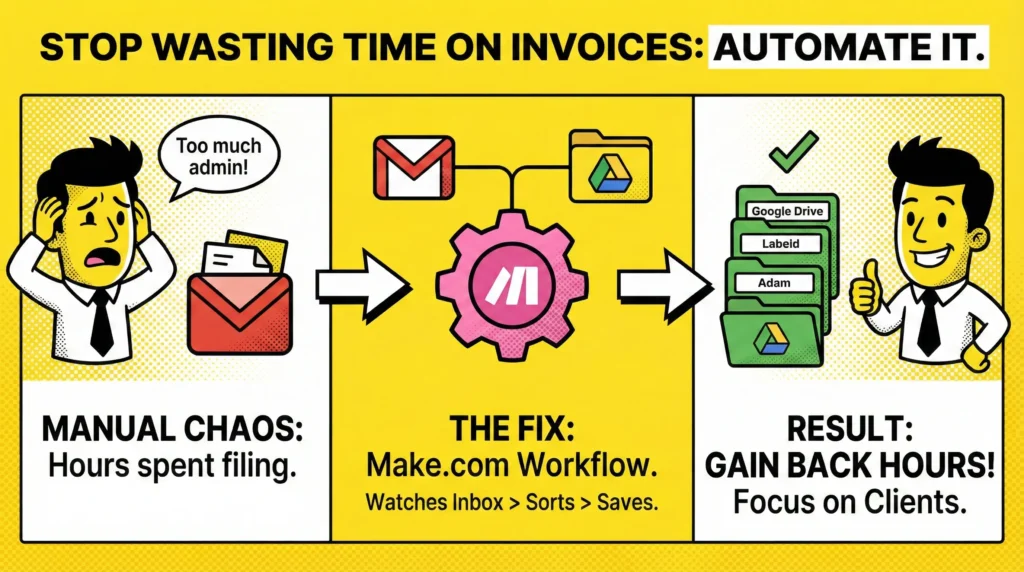
To tackle this, business owners must carefully evaluate how their time is spent. Identifying which tasks can be automated is a crucial first step. Platforms like Make.com offer numerous workflows that can help automate repetitive tasks, freeing up time for more valuable activities. For instance, our Auto-File Invoices workflow allows you to automate the filing of invoices directly from Gmail to Google Drive, reducing the manual work involved in handling financial records.
By understanding the implications of spending too much time on admin, business owners can start to strategize how to better allocate their time and resources. This strategic reallocation can significantly improve productivity and open up more space for activities that contribute directly to revenue and client satisfaction.
The Essential Balance: Admin vs. Revenue-Generating Work
Achieving the right balance between administrative duties and revenue-generating work is crucial for sustainable business growth. Too much admin not enough client work is a surefire way to slow down business momentum. The key is to streamline and optimize your administrative processes to ensure that they don’t overshadow the work that directly impacts your bottom line.
One effective strategy is to automate as many routine tasks as possible. Automation tools can help reduce the manual load, allowing you to focus on activities that require your expertise and direct involvement. For example, the Booking Assistant workflow can automate booking management by integrating with tools like Calendly, Calendar, Email, and MailerLite. This means less time spent organizing and confirming appointments, and more time engaging with clients.
Moreover, leveraging automation can lead to more consistent and accurate outcomes, as automated processes are less prone to human error. By investing in the right tools and technologies, you can enhance efficiency and ensure that administrative tasks are handled seamlessly in the background.
The right balance between admin and revenue-generating work allows business owners to deliver more value to clients while maintaining operational efficiency. The time saved through automation can be reinvested into business development, strategy, and client relations, leading to long-term success and growth.
Implementing Automation: A Practical Approach
Transitioning to an automated setup requires careful planning and execution. While the prospect of automation is appealing, it’s important to approach it with a clear plan and realistic expectations. Too much admin not enough client work can often tempt business owners to rush into automation without a proper strategy.
Start by identifying the tasks that are repetitive and time-consuming. These tasks are prime candidates for automation. For instance, the Review Response Bot workflow can manage and respond to Google My Business reviews using AI, eliminating the need for manual responses and ensuring timely interactions with clients.
It’s essential to adequately train yourself or your team on the automation tools you decide to use. Platforms like Make.com offer a variety of workflows that cater to different business needs, but each comes with its own learning curve. Investing time in learning how to effectively use these tools will pay off in the long run, as it ensures that the automation functions as intended and delivers the desired outcomes.
Furthermore, always monitor and evaluate the performance of your automated processes. Regular reviews will help you identify any issues early and allow for timely adjustments. Automation is not a set-and-forget solution; it requires ongoing attention and refinement to ensure it continues to meet evolving business needs.
By taking a pragmatic approach to implementing automation, you can minimize disruptions and maximize the benefits, ultimately shifting the balance from too much admin not enough client work to a more productive and rewarding workflow.
The Long-Term Benefits of Automation
Embracing automation offers numerous long-term benefits, particularly in addressing the issue of too much admin not enough client work. When implemented correctly, automation can lead to significant improvements in efficiency, productivity, and overall business performance.
One of the main advantages of automation is the ability to scale operations without a corresponding increase in administrative workload. For instance, the Instant Quote Machine can automate the creation of quotes, transforming what was once a manual process into a streamlined, efficient operation. This not only saves time but also enhances client satisfaction by delivering quick, accurate quotes.
Additionally, automation can provide valuable data insights that inform business decisions. By automating processes, you can collect and analyze data more efficiently, gaining insights into customer behavior, sales patterns, and operational efficiencies. These insights can drive strategic decision-making and foster innovation.
Moreover, automation can help reduce costs associated with manual processes. Labor-intensive tasks can be simplified and expedited, allowing for better resource allocation and cost management. This financial efficiency can be reinvested into other areas of the business, further driving growth and development.
Ultimately, the long-term benefits of automation extend beyond mere efficiency gains. They encompass improved customer experiences, enhanced business agility, and the capacity to focus on strategic initiatives that propel the business forward. By shifting the balance away from too much admin not enough client work, automation empowers business owners to achieve their goals while maintaining a competitive edge.
Conclusion
In conclusion, finding the right balance between administrative duties and revenue-generating work is crucial for any business owner. The challenge of too much admin not enough client work is a common hurdle, but one that can be effectively addressed through strategic use of automation. By leveraging tools like Make.com and implementing tailored workflows, business owners can free up valuable time, enhance operational efficiency, and focus on activities that drive growth and success.
It’s important to approach automation with an understanding of its potential and limitations. While it offers significant benefits, it requires careful planning, continuous learning, and regular evaluation to ensure it meets the needs of the business. By addressing the imbalance of administrative and client work, business owners can unlock new opportunities for themselves and their businesses, ultimately leading to greater satisfaction and profitability.
As you navigate the complexities of running a business, remember that automation is a powerful ally in shifting the focus from too much admin not enough client work to a more rewarding, client-centric approach. Embrace the change, invest in the right tools, and watch your business thrive.


Susana Toth
Make.com Certified Expert & Founder, La Maquina Studio
Susana Toth is a Make.com Certified Expert and the founder of La Maquina Studio, where she helps small businesses and consultants eliminate repetitive work through smart automation. With 20+ years of experience in web design, business consulting, and digital strategy, she builds practical AI-powered workflows that save hours every week — without writing a single line of code. She writes about Make.com automation, AI integration, and building systems that work while you don’t.
Learn more about me →